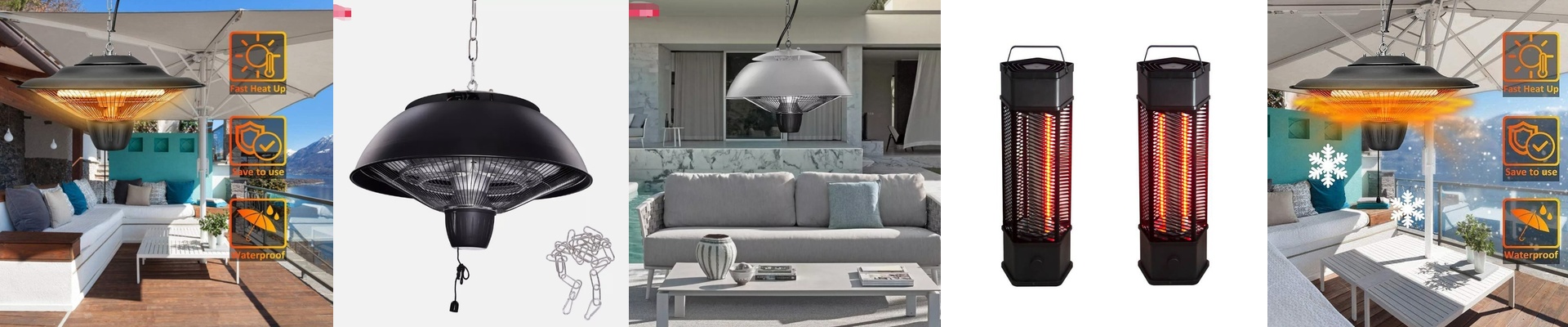
We build patio heaters for restaurants, and honestly? The whole thing hinges on one tough piece: the high-output halogen tube. Because when you’re running a patio, you need a heater that fires up the second you flip the switch. It has to throw off serious, direct warmth. And it has to live outside—day after day, night after night. So the tube has to be built to handle intense heat and keep a rock-solid electrical connection, no matter what the weather throws at it. Here’s the thing about the power setup. We spec these tubes at 2500W, and they’re designed to run on either 230–240V or 400V. Running at higher voltage means less current for the same wattage. That keeps the wiring simpler and cuts down on power loss in the heater leads. And the tube itself? It’s about 300mm long. So it’s compact enough to fit neatly inside a standard reflector, but long enough to create the right path for powerful infrared heat. Then we get into the materials. The emitter sits inside a quartz envelope with a halogen cycle. That lets the filament run hotter without the tube quickly going dark. The payoff is simple: the heat stays strong and steady over the tube’s whole life. For the connection, we use an R7s connector. It’s there for a reason. It handles the high current, makes swapping out a tube easy, and gives you a solid, aligned contact that won’t spark or arc, even when the heater is switched on and off again and again. Now, think about what that means on a restaurant patio. You don’t want heat that slowly warms the air. You want warmth that reaches people fast—the kind that hits tables and faces directly. Halogen tubes do exactly that with direct infrared radiation. But that power comes with a trade-off. At 2500W, you’re dealing with serious heat density. So the reflector and mounting have to be designed to manage the temperature, and the enclosure needs proper ventilation to keep everything from overheating.