Out on the glass processing floor, quartz doesn’t cut you any slack when the heat is off-center. You know the drill: a hotspot in the middle, edges running cooler, and suddenly the material pushes back—micro-cracks during forming, viscosity that shifts across the melt, and yield that falls when you need it climbing. When the heating profile is wrong, every station downstream takes the hit. We designed our infrared heat treatment modules for quartz around one hard truth: heat has to land where it’s needed, when it’s needed, without chasing thermal lag down the line.
What actually matters
Infrared treatment for quartz isn’t about raw power. It’s about controllable radiation, repeatable temperature distribution, and steady performance on a continuous run.
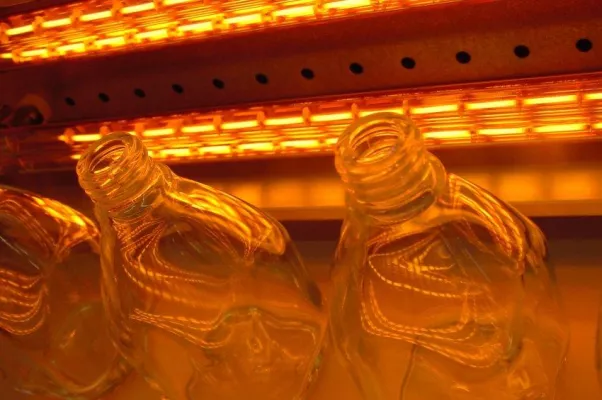
- Uniform thermal field: Our infrared emitters are built to lay down a consistent thermal field across the target surface. With quartz, that means predictable softening and fewer stress gradients during forming or annealing. Fewer rejects tied to uneven heat.
- Fast response, repeatable cycles: Infrared responds almost instantly because energy transfer is direct—no waiting on a big mass to heat up. In practice, you get shorter ramp-up, tighter soak windows, and quicker changeovers between batch sizes. That matters when your line is juggling mixed orders.
- Directional radiation, less wasted energy: Infrared energy goes where you point it, cutting losses to convection and surrounding structure. That boosts energy efficiency and helps stabilize the surface temperature where it counts—especially when quartz’s low thermal conductivity would otherwise widen the edge-to-center gap.
- Process-ready output: Industrial infrared systems are specced to match the line—voltage, power density, and emitter geometry are chosen to fit the oven or furnace you already run. The point isn’t to redesign the line around the heater; it’s to make the heater work inside the process you have.
Why this approach fits quartz
Quartz heat treatment is unforgiving because the material’s properties shift sharply with temperature, and thermal stress builds fast. Uneven heat gives you warping, striae, and fractures that show up immediately—or later, in inspection. A slow system bleeds minutes on every cycle, and those minutes add up to lost capacity. Infrared tackles both failure modes.
- Quality and yield, in the same pass: A uniform thermal field cuts down localized overheating and steep thermal gradients. You get more consistent viscosity across the part, which supports cleaner forming and lower internal stress after annealing. On the floor, that translates to fewer cracks, fewer optical defects, and more parts that meet dimensional and surface specs on first inspection.
- Throughput you can count on: Fast response means you can run short, repeatable heat cycles without overshooting the setpoint. Hold a precise soak without overheating, then reset fast for the next batch. Takt time stays predictable, and scrap from waiting on the system to stabilize drops.
- Energy use that behaves like a variable, not a fixed cost: Directional radiation keeps more energy on the workpiece instead of heating the enclosure. In a high-uptime plant, even a modest reduction in energy per part adds up fast—especially on multi-shift schedules.
- Drops into what you already run: Infrared modules can be integrated as direct replacements or upgrades in many existing furnace and oven setups. The gain isn’t a new machine; it’s a more controllable heat source inside the machine you already operate.
What to watch for
Infrared treatment for quartz is solid, but it still needs the right operating conditions to perform consistently.
- Line of sight matters: Infrared transfers energy by radiation, so obstructions—fixtures, shields, or misaligned tooling—create shadows and localized cold spots. Fixture design has to keep the emitter field unobstructed, or you lose the uniformity advantage.
- Match emitter selection and setpoint to the work: Not every infrared profile fits every quartz thickness or geometry. If the emitter temperature is too low, efficiency falls off. Too high, and you risk surface overheating before the core gets to target. The system has to be matched to part geometry and cycle time.
- Control strategy is part of the hardware: The best results come when the infrared zone is paired with closed-loop temperature sensing and a control method that can follow the required ramp and soak profile. Without that, you still get heat—but you lose repeatability.
- One practical constraint: Infrared systems are sensitive to surface condition and emissivity changes. If your process leaves residues or shifts surface reflectivity from part to part, you may need to adjust the calibration window or add a consistent pre-clean step to keep the heating profile stable. If your plant lives by stable quartz properties and repeatable cycle times, the real question isn’t whether you can heat the glass. It’s whether you can hit the right profile, every time. Infrared treatment gives you uniform thermal fields, fast response, and directional energy transfer—three levers that directly move yield, throughput, and energy cost in your day-to-day operation.